
The First Amendment:
About Substack’s Nazi newsletters.

The Guardian’s February 7 article about Substack hosting extreme-right newsletters on its platform and making money from it certainly isn’t the first time I read about this accusation. Two years ago, The Atlantic published “Substack Has a Nazi Problem”, and many Substack users threatened to leave. Around the same time, people such as popular tech journalist Casey Newton (Platformer) moved their newsletters from Substack to Ghost, a non-profit organization using Open Source software, because they objected to Substack’s failure to stop extremist content.
Here is the problem: According to the Atlantic article from 2023, Substack hosts white supremacists, Holocaust deniers, anti-semites and other racists, neo-Nazis, and similar unsavory characters on its platform. Substack’s co-founder Hamish McKenzie defended their policy of promoting civil liberties and objecting to censorship. “We don’t like Nazis either,” he wrote, “but…” They’re against censorship. They support individual rights and civil liberties. They have guidelines that prohibit incitement to violence. Sounds good, right?
And then, last July, a number of Substack users received a push notification – a promotion sent from Substack encouraging users to subscribe to a Nazi-blog. With a swastika logo. People were rightfully shocked, and a Substack spokesperson quickly apologized and declared that it had happened because of an error, a technical glitch. Won’t happen again. However, anybody who received the push alert and clicked on the profile was recommended further Substack blogs with explicit anti-Semitic and racist content. Substack “now functions much more similarly to a modern social media app with algorithmic recommendations fueling internal discovery and growth. Push alerts and features like the “rising” lists show that the app is doing active promotion of some content”1, some users claim. It seems to come down to money; Substack takes a portion of every paid subscription, and despite their solemn assertions that they’re idealistic and all for democracy the bottom line is profit. Quite disappointing. A user like me with very few paying subscribers can’t move to another platform. The alternatives either lack some of Substack’s functionality or require a monthly fee that I simply can’t pay.
The whole controversy had me ponder once again about the First Amendment, Freedom of Speech. I’ve often mentioned that I grew up in Germany right after the Nazi era. Its symbolism and vocabulary were simply verboten – you were not allowed to say “Heil Hitler”, you were not allowed to read “Mein Kampf”, you were not allowed to wear a pin with a swastika. Holocaust Denial was something unthinkable. Look up Section 86a of the German Criminal Code, and you learn that any infraction of this law can carry a prison sentence of up to five years. 2026 will bring some changes to this legislation; for example, it will be allowed to display a swastika in educational or artistic contexts, but it will remain illegal for propagation of hate or Nazi ideologies.
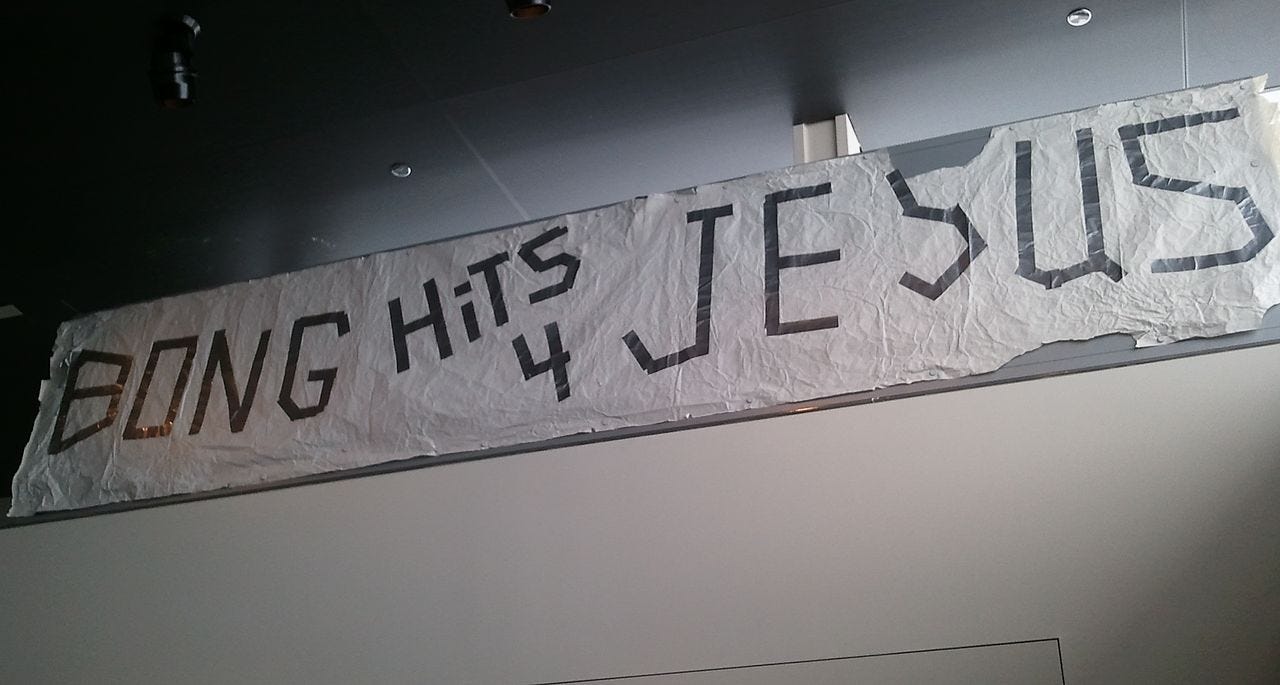
Coming from a background like that, I’ve always considered the Free Speech part of the First Amendment a bit too permissive. I understand why people would fiercely defend the right to speak freely, to maintain a free press. But there’s always a subjective element, even when a decision goes all the way to the Supreme Court (which currently few people would consider to be objective, anyway). From Wikipedia: “While freedom of speech is considered by the United States to be a fundamental right, it is not absolute, and therefore subject to restrictions.” There are all kinds of restrictions; follow the Wikipedia link and you’ll see a long list of what’s excluded from the right to free speech. Not all of it makes sense to me, and some restrictions seem open to subjective interpretation. Look at Morse v. Frederick for example, about a student (Joseph Frederick) displaying the banner below during an event at his high school. It went all the way to the Supreme Court, where Chief Justice John Roberts ruled that Frederick’s banner was not protected speech because it could be viewed as promoting illegal drug use at a school-sanctioned event. I’d view it as a prank.
While many countries ban Nazi symbols, like most European countries, Canada and the United States for example don’t. Canada, however, prohibits public statements that incite hatred against an identifiable group or that promote genocide. The United States doesn’t similarly limit freedom of speech, even hate speech is protected. Some states have their own laws concerning Nazi symbols; Virginia, for example, bans their public display in order to avoid confusion with the Hindu swastika. It is, after all, a symbol that’s part of the spiritual heritage of humanity, the earliest manifestations dating back to 17,000 BCE – the Paleolithic or Old Stone Age. It’s a shame that the Nazis usurped the symbol. I remember my shock when I first saw it in temples in India…
When I looked closer at the Wikipedia page which lists the countries that do and that don’t ban Nazi symbols, I started to wonder whether it does make any difference. Even in Germany far-right ideologies are popular, neo-Nazis have been around forever, and xenophobic nationalism and antisemitism are widespread. Same in Austria and the Netherlands, where the promotion of any kind of Nazi ideology is strictly forbidden. Maybe it doesn’t matter so much what’s allowed and what’s forbidden, it depends more on the government. The current regime with its incessant lies, constant attacks on journalists, and violent crackdown on people peacefully exercising their right to voice their opinion tramples on the First Amendment with impunity. People who spoke their mind about far-right activist Charlie Kirk after he was shot lost their jobs. Students who protested the genocide of Palestinians in Gaza were arrested and expelled from their universities. And we’ve seen what happens to those who protest against ICE and its vicious, cruel treatment of brown-skinned people in Minneapolis, for example: some of them are dead.
Getting back to Substack: Maybe it really doesn’t matter all that much whether the platform would ban all the Nazi sympathizers or not. Banning conspiracy theories, Hitler-praising blogs, or any other extremist content doesn’t make them go away, on the contrary – they only become more interesting to some. But the fact that Substack actively promotes blogs with such questionable messages to make more money, while claiming that they don’t like Nazis – that’s disappointing and dishonest.
Right.. and you don’t establish gun laws because you don’t agree with it.. who cares about the carnage happening every year.. constantly…only in the US..
One of the dumbest takes I have read. 1St amendment rights are protected speech, PERIOD! You don’t get to ban speech just because you don’t agree with it. If that were so I’d welcome you all back to September 1st, 1939. Weaponization is where it leads!