
White Stripes
No, not THE White Stripes, and not zebras or tigers either.

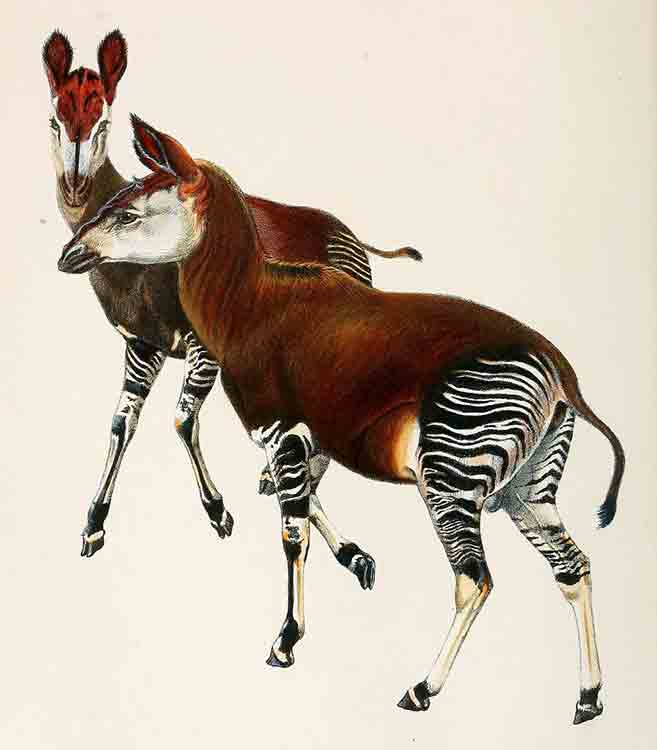
There’s another beautiful creature with white stripes, the Okapi. And it’s actually related to giraffes! A shy and elusive animal, it was discovered by Western scientists in 1901 only. There were rumors among European explorers in the 19th century about an African unicorn, and the travelogues of the Welsh/American discoverer Henry Morton Stanley mentioned a kind of donkey which later researchers identified as an okapi. Its scientific name is Okapia johnstoni, after another explorer, the British botanist and artist Harry Johnston, correctly recognized it as a relative of the giraffe. Actually, Johnston never saw an okapi but only had a skull and pieces of striped fur to classify the animal.
According to Wikipedia, Johnston was the British special commissioner to Uganda when he found out that some pygmies were being abducted by a Western showman who wanted to display them in something like a zoo. This was nothing unusual – I wrote about Ota Benga, a Pygmy man from the Congo who was exhibited at the St. Louis World’s Fair in 1904, and at the Bronx Zoo in 1906. Johnston rescued the people and returned them to their homes. In exchange, they helped him identify the animal he had seen tracks of, although he never saw a life okapi.
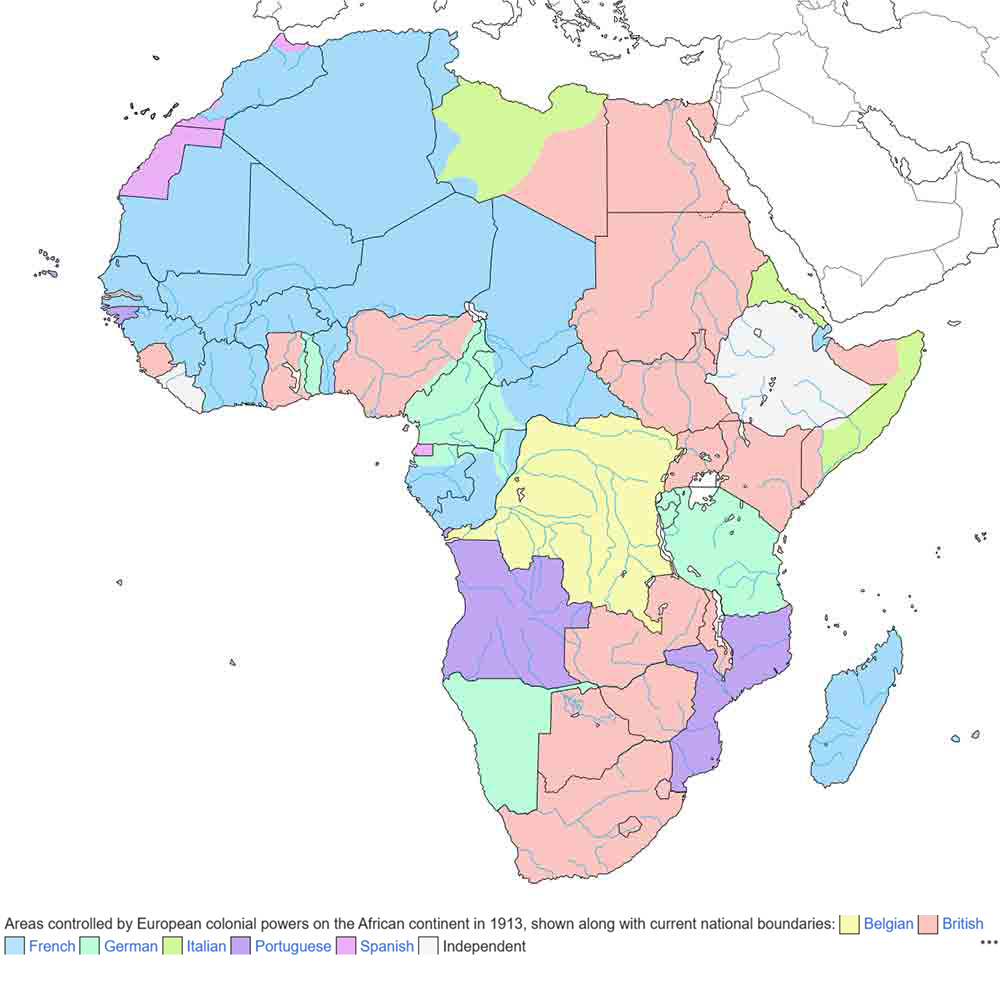
When I looked at several Wikipedia pages about the various Western explorers of Africa, to read about the imperial rush from European nations to cut up the continent for their own benefit was rather shocking. Of course I knew about it, but to look at the map below and realize that seven countries – Belgium, Britain, France, Germany, Italy, Portugal, and Spain – had invaded this vast area and, because of their technological superiority, decided they could capture and enslave its peoples and exploit its resources – it’s shocking, no matter how often you hear it. And to know that there are people today with the same mentality, who assume that was all correct and that the United States should adopt or return to this mindset – well, that’s outright crazy.
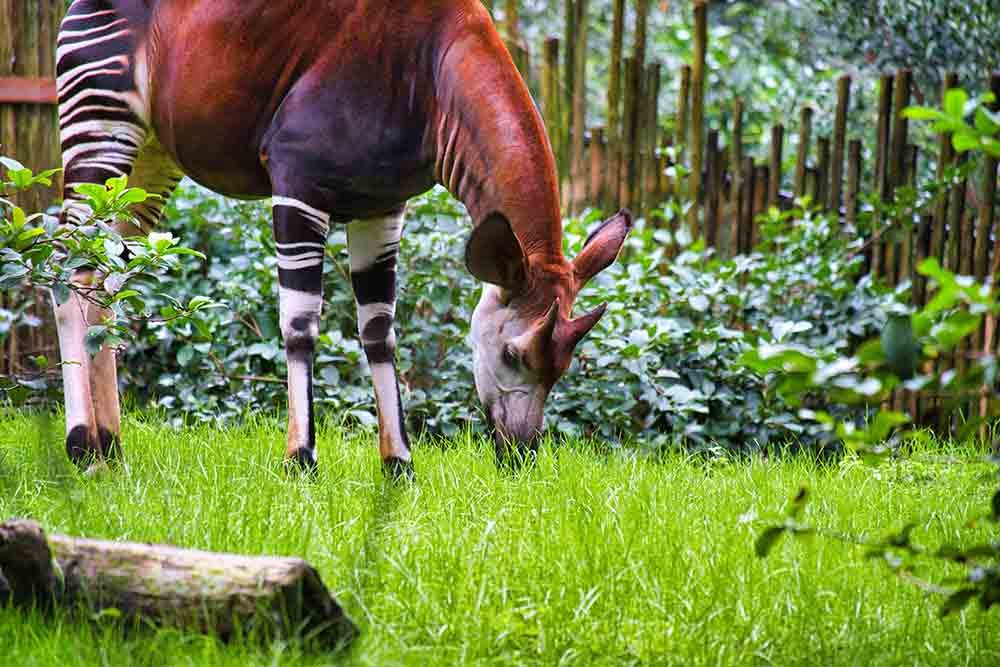
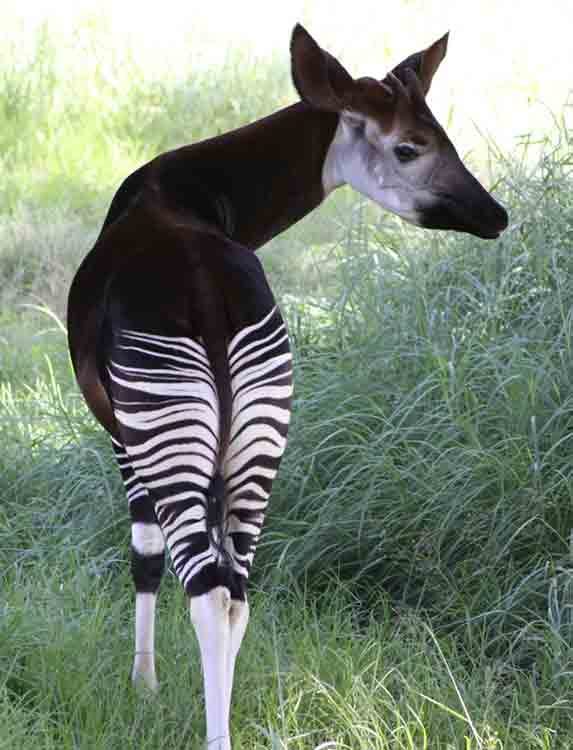
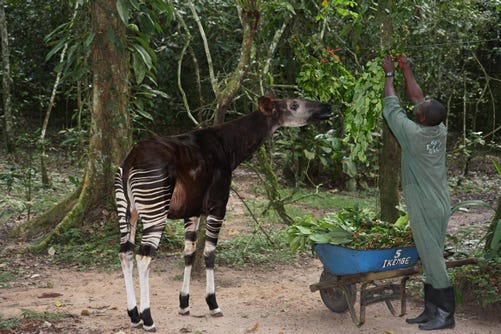
Back to okapis. Although they don’t look anything like giraffes, there are some similarities: male okapis also have horn-like structures covered with skin and hair, called ossicones. They are herbivores, and have four stomachs which help with the digestion of tree leaves and buds, twigs, fruit, and other vegetation. Again like giraffes, they grab high-growing branches with muscular, prehensile tongues that are about 18 inches long and strip the leaves off. In photographs, the bold stripes catch our attention, but in the rainforests where okapi live it’s the perfect camouflage: they mimic streaks of sunlight shining through the trees. That’s why few of the early European explorers ever saw the shy animal.
There’s only one small region in all of Africa where they can be found: in the forests in the northeastern part of the Democratic Republic of Congo. Nowhere else in the world! In November of 2013 okapis were reclassified as ‘Endangered’ in the International Union for Conservation of Nature (IUCN) Red List of Threatened Species. Originally, they were listed as ‘Near Threatened’. The okapi’s numbers have been steadily declining since 1995, due to a combination of human settlement, deforestation and forest degradation. By 2013 the population had declined to 10,000 animals in the wild, down from an estimated 40,000 a decade earlier.
The Okapi Conservation Project (OCP), a non-profit organization founded in 1987, operates in the DRC to protect the natural habitat of the okapi as well as the habitat of the indigenous people living in the Okapi Wildlife Reserve, one of the most biologically diverse areas in all of Africa. The Okapi Wildlife Reserve covers a 13,700-sq-km tract (about one-fifth) of the Ituri Rainforest in northeastern DRC. It was created by the Congolese government in 1992 in the face of widespread civil unrest, as an effort to preserve the rare plant and animal life and human cultures within. It is a UNESCO World Heritage site and is home to bonobos (a critically endangered great ape), chimpanzees, monkeys, hundreds of different bird species, antelopes, leopards, forest buffalos, elephants, and many butterflies and other insects.
The Ituri Forest also is home to the indigenous Mbuti pygmies, hunter-gatherers who are one of the oldest forest-dwelling people on earth. The Okapi Conservation Project protects these people and their way of life as well. The eastern part of the Democratic Republic of the Congo is politically unstable and militia fighting, illegal poaching, illegal logging, illegal mining for gold, cobalt, and other minerals pose a threat not only to the okapis but also to the way of life of the pygmy population. And the people who protect the okapi and the preserve are not safe either: in 2012 some militia bands and poachers attacked the headquarters of the Okapi Wildlife Reserve, killing six people and 13 okapis. The Congolese army sent troops, many conservation organizations sent funds to rebuild the destroyed facilities, and the Congolese Institute for Nature Conservation (ICCN), a Congolese governmental partner, is tasked with the protection and conservation of the forests which are home to the okapi and other endangered animals, as well as indigenous peoples.
I couldn’t verify whether the ICCN is currently operational. The link to their official website brings up a Thai gambling enterprise. The Okapi Conservation Project claims that 330 trained ICCN rangers protect the endangered species and habitats daily, and that poaching has dropped by 60%. I hope that’s correct.
When I consider the Indigenous communities who have lived in harmony with its wildlife for 40,000 years, have coexisted with the Okapi, holding it in high regard and incorporating it into their folklore and traditions, I seriously question humanity’s “progress” with all its technological advances. Yes, I value Western culture’s achievements (thinking especially of art and literature) but somewhere something went wrong. Somewhere along the way the connection to other living beings, big and small, has been lost. Money, craving for possessions, the need to always get more, something bigger and better, has cut us off from “the Other”, whether that’s humans who are different, or other creatures whose right for a decent life we constantly deny. Our egocentricity has cut us off from life, at our peril.
Please watch the video below of the friendship between Richard Gelo, a farmer, and the okapi who regularly visits him; the first time this connection between an elusive okapi and a human has ever been witnessed by conservationists.
Jessica, you post the most interesting stuff! Thanks.